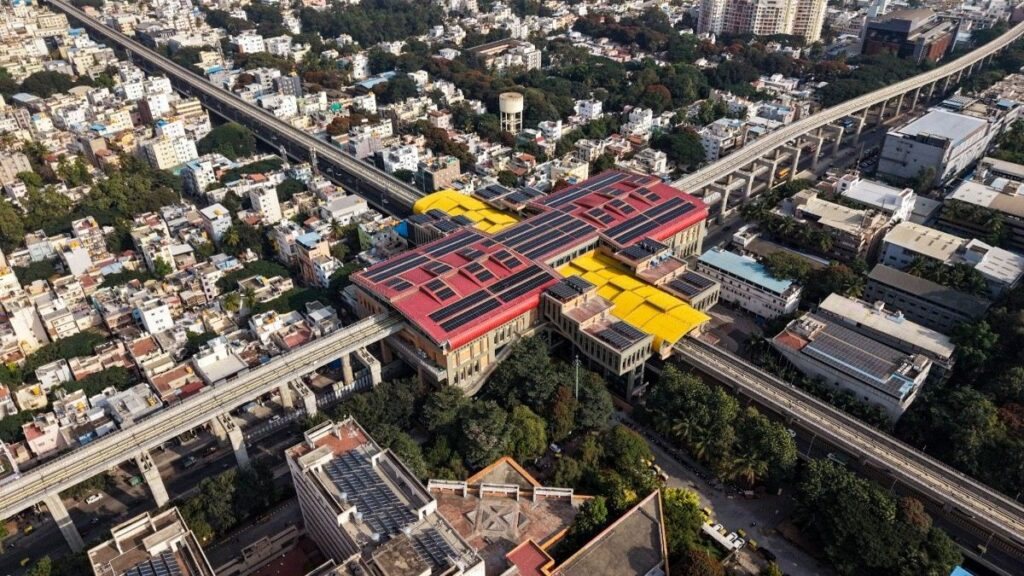
Prime Minister Narendra Modi is scheduled to inaugurate the elevated stretch of the Pink Line of the Bengaluru Metro on November 13, a 7.5 km section running from Kalena Agrahara to Tavarekere. The launch comes at a time when the Karnataka government and the Union government are in a sharp public dispute over how the cost of the city's Metro expansion is shared.
The Karnataka government says it bears 84 per cent of the cost of the Metro project. According to state figures, the total cost of Phases 1, 2, 2A, 2B and the proposed Phase 3 stands at Rs 77,891 crore, of which the state's share is Rs 65,291 crore and the Centre's share is Rs 12,600 crore. The state says its contribution also covers land, taxes, interest payments and operating losses.
The Bharatiya Janata Party has put forward a different picture. Its leaders argue that the Centre's sovereign guarantee backs foreign loans worth Rs 28,958 crore, and that the Centre's revised share of the project is 53.35 per cent against 46.65 per cent for the state. The central point of disagreement is who is responsible for repaying that Rs 28,958 crore foreign loan. Former chief minister Basavaraj Bommai has said the loans are repaid from ticket revenue rather than from government treasuries. BJP MP Tejasvi Surya has led the party's counter-argument on the funding figures.
The political friction has also surfaced around the inauguration programme itself. Minister Krishna Byre Gowda's speech was dropped from the official programme, and Congress leaders have alleged that Gowda was sidelined because of the state's demands on funding. The state government has pressed the Centre on the matter, and the event is likely to keep the funding question in public view.
Ownership of the Bengaluru Metro Rail Corporation Limited, which builds and runs the network, is shared equally between the Centre and the state, with equity of Rs 9,164 crore each. The corporation's own accounts show the strain of the arrangement. Its 2025–26 revenue was Rs 1,625 crore, of which Rs 1,126 crore came from ticket sales, while the accounting loss for the year after depreciation and interest was Rs 1,710 crore. The state has paid Rs 1,046 crore towards operating losses, with Rs 52 crore still pending reimbursement.
The revenue base is also a point of comparison in the debate. Bengaluru's average fare is Rs 3.97 per kilometre, against Rs 3 per kilometre in Mumbai. Non-fare revenue accounts for between 1.39 and 8.62 per cent of the Bengaluru Metro's income, far below the more than 20 per cent earned by the Delhi Metro. These figures bear directly on how far ticket income can cover the loans and operating costs that the two governments are disputing.
The Pink Line has a longer history than the current dispute. The Centre approved the line in 2014, and the civil contract was awarded in 2017. Surya has said that 72 per cent of the tunnelling was completed during the 2019–2023 BJP government in Karnataka, and has blamed technical changes made by the state for delays in Phase 3. The network stands at 96.1 km and is expected to reach 103.6 km after its planned expansion. A single-day ridership record of 11.92 lakh passengers was set on October 16, underlining the scale of demand the system now carries.
The proposed Red Line, a 37.8 km corridor from Sarjapur to Hebbal, has had its cost revised to Rs 25,999 crore. As of November 2026, it was still awaiting the Centre's approval, leaving one more large project tied to the same unresolved question of how the costs of Bengaluru's Metro will be divided.
Source: tezzbuzz.com
3