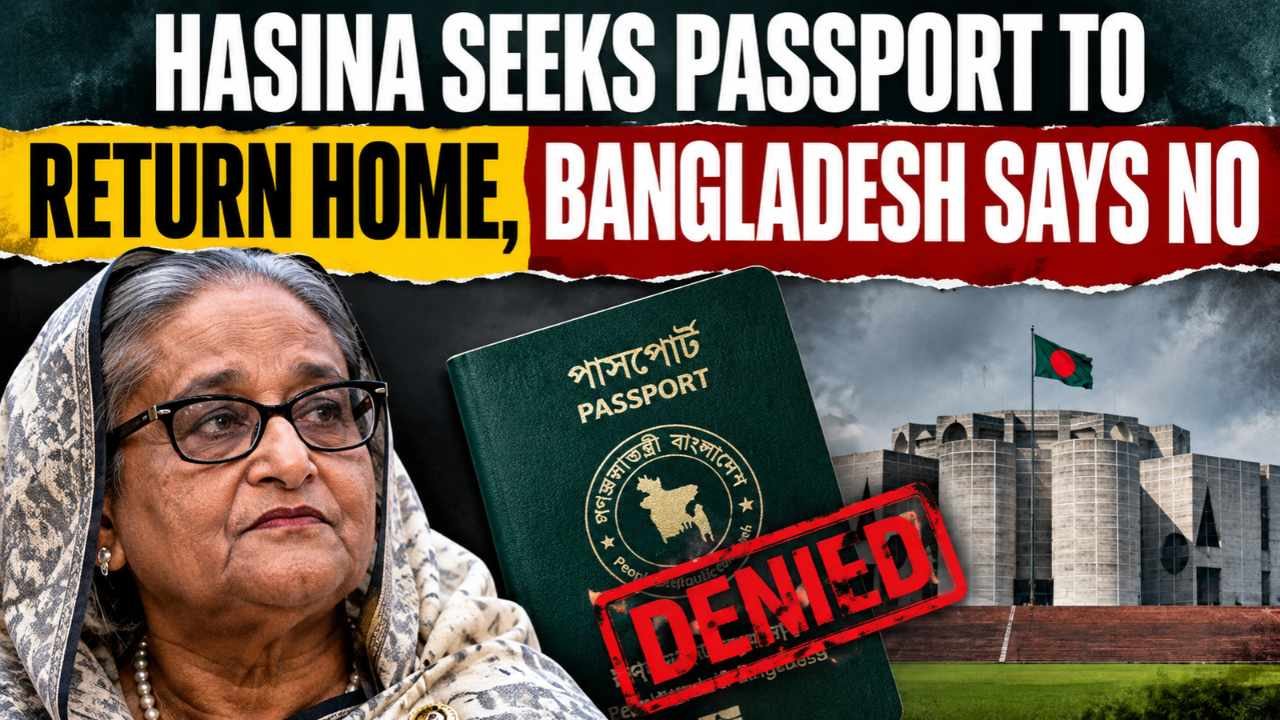
Bangladesh’s chief prosecutor, Md Aminul Islam, has described a request by former prime minister Sheikh Hasina for a new passport and national identity card as political posturing, saying the government has no intention of allowing her to return. The request was reportedly linked to a planned return to Bangladesh in December. According to the prosecutor, no formal legal or administrative steps have been initiated to support such a return, and the application should be read as a political manoeuvre rather than a genuine step towards homecoming.
Hasina has lived in India since fleeing Dhaka in August 2024, when mass protests against her government culminated in the end of her long tenure as prime minister. Since then, Bangladesh’s International Crimes Tribunal has sentenced her, along with former Home Minister Asaduzzaman Khan Kamal, to death in absentia. The charges are crimes against humanity linked to the crackdown on the July 2024 uprising. The tribunal is headed by Justice Md Golam Mortuza Mozumder, and the verdict has become the central legal fact shaping the current standoff between Dhaka and New Delhi.
The Bangladeshi government has refused to issue Hasina a passport and has described her as a fugitive terrorist. Dhaka is seeking her extradition from India, and New Delhi has received those requests. No decision has yet been announced on handing her over, and the requests are being considered through the routine processes of the Ministry of External Affairs. The absence of a decision means that the legal status of a convicted former head of government now living across the border remains unresolved.
Hasina has denied any wrongdoing and has disputed the legitimacy of the tribunal that convicted her. Her supporters in the Awami League, most of whom are now in exile, have claimed that preparations for her return are under way. The prosecutor’s statement stands in direct contrast to those claims, and it indicates that the Bangladeshi state does not regard the Awami League’s assertions as reflecting any action on the ground.
The central uncertainty is whether Hasina could return without a valid travel document. Some observers have argued that citizenship alone may be sufficient to permit her entry, since a passport is a travel instrument rather than the source of nationality. The government’s position, however, is that without a passport and the state’s cooperation, any return would be irregular, and that a person facing a death sentence cannot be treated as an ordinary returning citizen. The question therefore sits at the intersection of citizenship law, the rights of a convicted person abroad, and an extradition process that has yet to produce a ruling between two neighbouring countries whose relations have been strained since the change of government in Dhaka.
For ordinary Bangladeshis, the dispute has revived debate over accountability for the 2024 crackdown, in which the tribunal’s proceedings have been the main formal avenue for examining the conduct of officials of the former government. For India, the case poses a diplomatic question about its obligations, if any, under extradition requests from a neighbour that has framed the matter in criminal rather than political terms. Neither government has indicated when a decision on the pending requests might be taken.
Source: pgurus.com
6